Video Doorbell FOV: Optimize Your Porch Coverage
By Diego Sato • 12th Apr
When you deploy a video doorbell camera, field of view (FOV) determines whether you capture the delivery person's face or just their knees. It controls whether you see a package placed on your stoop or only the aftermath. And it dictates how many false alerts your staff or household will tolerate before silencing notifications entirely. FOV isn't glamorous (it won't appear in marketing shots), but it's the metric that separates gear that actually works in your space from gear that creates busywork.
Understanding FOV security coverage means moving past manufacturer specs and into your actual porch, hallway, or storefront. This guide walks you through the mechanics, the trade-offs, and a framework for measuring what you actually need.
1. Understand the Two Dimensions of Doorbell FOV
Manufacturers typically advertise a single FOV number (often 160° or 180°), but that's usually horizontal FOV only. For brand-by-brand FOV charts and package coverage examples, see our 180° doorbell cameras. What matters for package detection and visitor recognition is the combination of horizontal and vertical field of view.
Horizontal FOV (left to right) determines whether you see someone approaching from the driveway or curb. A narrow 100° horizontal FOV might miss a courier walking up the side of your porch. A wide 160° horizontal FOV captures the whole entrance plus context, but may include sidewalk traffic that triggers false alerts.
Vertical FOV (top to bottom) is where most deployments fail silently. A typical doorbell mounted 4 feet above ground with narrow vertical FOV sees mostly the torso and feet of visitors, not faces. Add a recessed doorway or a tall delivery person, and you're recording shoes and legs. Vertical FOV of at least 65-75° is necessary to capture faces at typical visitor distances (3-8 feet from the door).
2. Know Why Vertical FOV Matters Most for Recognition and Thresholds
You can recognize a courier, neighbor, or thief only if you see their face. A wide horizontal FOV is nearly useless if your camera doorbell only captures their torso and the ground below.
Consider threshold visibility: if your doorstep coverage includes a recessed entryway or an overhang, a doorbell positioned 5 feet up with 55° vertical FOV will show mostly shadow and overhead eaves. A doorbell with 75° vertical FOV, even in the same location, will angle down enough to catch the visitor's upper body and face in ambient light.
For businesses or multi-unit properties tracking deliveries and incidents, vertical FOV becomes a liability metric. A narrow vertical view means partial evidence and disputes about whether an interaction occurred.
3. Measure Your Effective Coverage Zone Before Buying
Real-world FOV performance depends on mounting height, distance to the target, and obstacles. Rather than trusting advertised specs, physically test.
For each potential doorbell location:
- Mark the mounting point on your door or frame (typically 4-5 feet above ground).
- Measure the distance from that point to where visitors typically stand (usually 3-6 feet away). Also note the nearest point (delivery person at your threshold) and farthest point (someone on the curb or hallway end).
- Estimate vertical sight lines: Does your porch have an overhang? Is there a recessed entry? Stand at visitor distance and look up at your proposed mounting point. Can you see your own face reflected, or just your torso?
- Check horizontal context: Walk left and right along your driveway or hallway. Would a doorbell see a car pulling up, a neighbor's porch, or just your entrance?
- Test at night: Doorbell FOV behaves differently in low light. An IR-illuminated narrow FOV can create glare on glass doors or overexpose near-field objects.
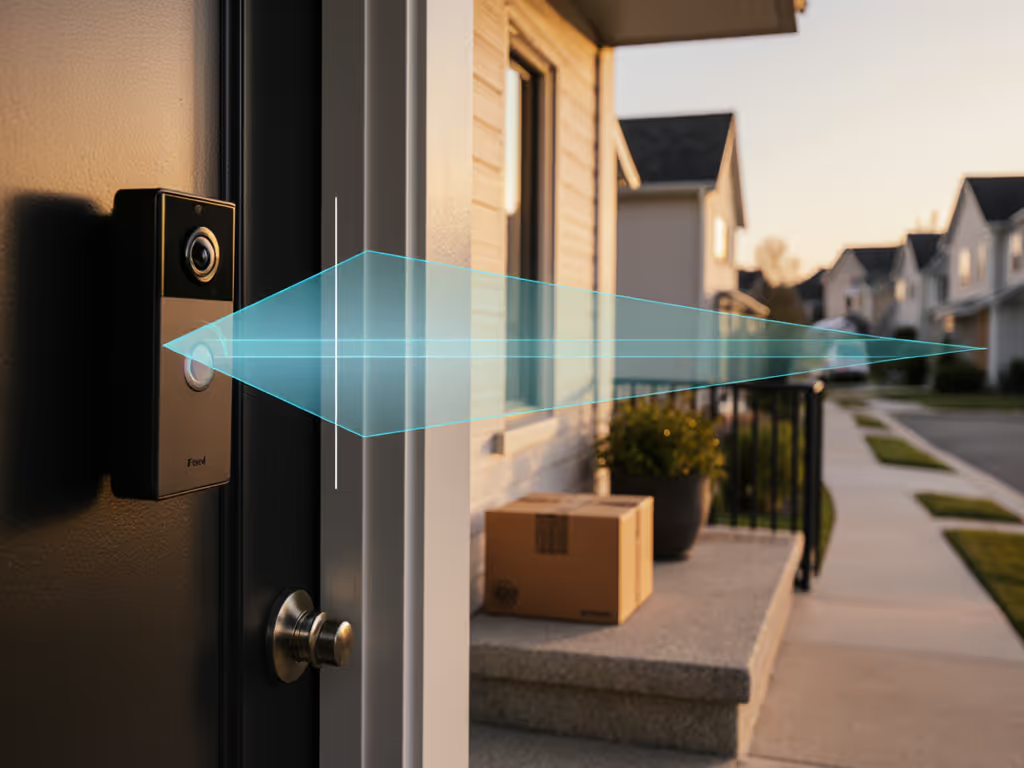
Once you've mapped the geometry, sketch a rough view cone. This is your operational reality, not the spec sheet.
4. Reconcile FOV with False-Alert Tolerance
Wide horizontal FOV captures more context but also invites sidewalk motion, passing cars, shadows, and insects. The bakery two blocks from my office lost package visibility not because their doorbell had poor FOV, but because it was so wide that buses braking on the curb triggered motion floods. When we swapped to a narrow FOV doorbell and zoned out the curb, false alerts dropped by 90%, and the shift manager finally got silence. That's the real lesson: optimal FOV isn't the widest lens available; it's the narrowest view that still captures your target zone without including irrelevant motion. If you're battling notification fatigue, compare models with advanced AI filtering to pair smart analytics with right-sized FOV.
For doorstep coverage, prioritize:
- The person-sized zone directly in front of your door (0-8 feet away, face-high).
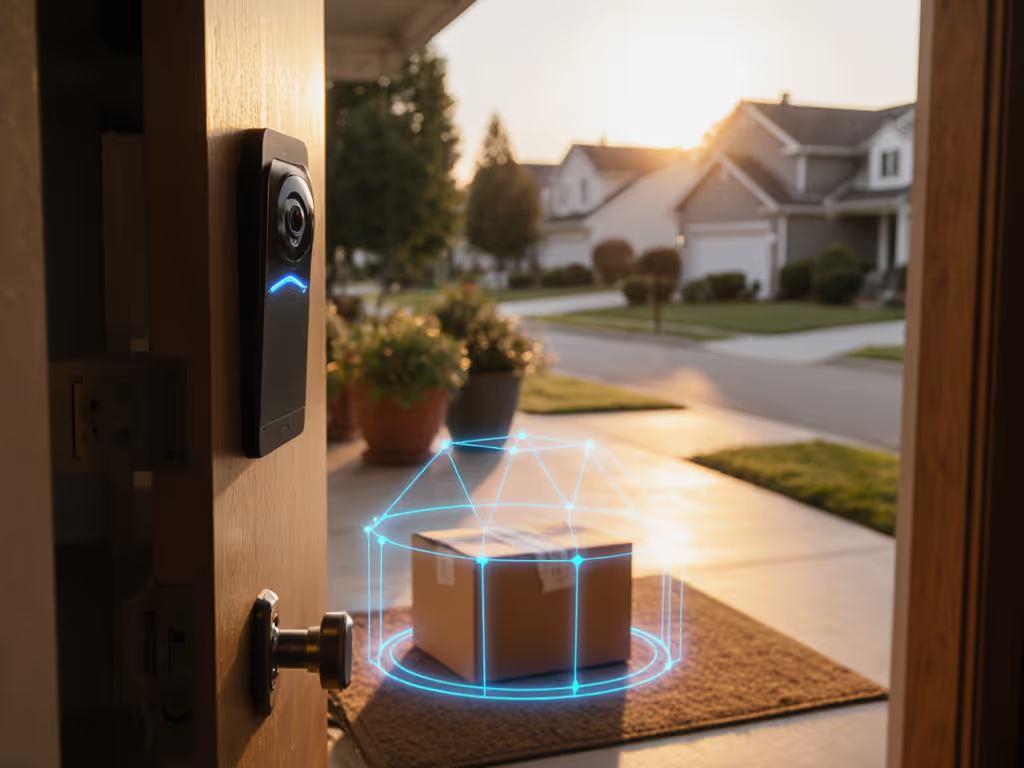
- Package drop points (often off to the side of the threshold).
- The approach path (driveway, stoop stairs, hallway section immediately outside your unit).
Everything beyond that is either context (nice to have) or noise (costly in false alerts).
5. Account for Vertical FOV in Narrow Spaces
Apartment hallways, narrow porches, and recessed doorways compress your vertical space. If your porch is only 4 feet deep before a wall, and the doorbell is 5 feet high, visitors are very close and very low relative to the camera. A doorbell with 55° vertical FOV will struggle because the angle of view skews downward steeply. You need 70-80° vertical FOV to keep faces in the readable zone when subjects are this close.
For condos and apartments, renters often can't choose mounting height. For non-permanent installs and lease-friendly mounting, see our no-drill renter installation. Vertical FOV becomes the lever: prioritize cameras explicitly designed with tall vertical FOV for close-range indoor use.
6. Test Night Performance and IR Reflections
Daylight FOV testing tells only half the story. To optimize low-light clarity and tame IR glare, see our night vision guide. At night, narrow vertical FOV combined with IR illumination can blow out the near-field (making faces unreadable) or create harsh shadows. Conversely, wide vertical FOV diffuses IR light over a larger area, reducing hot spots but weakening distant detail.
Before committing:
- Borrow or demo a doorbell in your actual space after dark.
- Record footage of someone ringing the doorbell at typical distance.
- Check for glare on storm doors, glass, or metal frames.
- Verify face legibility at both close range (threshold) and far range (curb or hallway end).
Wide horizontal FOV is nearly useless at night if your vertical FOV crushes the subject into the bottom third of the frame, where lighting is worst.
7. Plan for Multi-Camera Strategies in Large or Complex Spaces
A single doorbell can't cover a sprawling driveway, multi-unit building entrance, or storefront with windows and a loading zone. Uptime beats glam shots, and uptime means adequate coverage without single points of failure.
For storefronts or property managers overseeing multiple doors:
- Deploy narrow-FOV doorbells at each entrance, each tuned to its specific geometry (recessed, wide open, tall, low).
- Use simple local recording (PoE NVR or on-device storage) to avoid cloud vendor lock-in and notification latency; for trade-offs, see our cloud vs local storage.
- Zone each camera to exclude irrelevant motion (sidewalk foot traffic, neighboring storefronts, public streets).
- Audit multi-user access so that staff, residents, or family see only relevant clips and alerts, not a constant feed.
A property manager with five doors doesn't need five cloud subscriptions and five notification channels. A single local recorder with role-based access reduces false-alert fatigue and maintains operational control.
8. Compare Vertical FOV Specs and Test Reality
Manufacturers often omit or obscure vertical FOV. Request it in writing or search for teardowns and user reviews that measure actual coverage. Some brands publish detailed specs; many don't.
When evaluating options, ask:
- What is the advertised horizontal FOV and vertical FOV (separately)?
- At what distance do faces become unreadable (blurry or too small)?
- Does the manufacturer provide a coverage diagram showing the view cone from mounting height?
- Have users reported poor facial recognition in real deployments?
Skepticism toward spec sheets is warranted. Operational reality, how many faces are actually readable in your hallway or porch, is the only metric that matters.
9. Adjust Mounting Height and Angle to Maximize Vertical FOV Usability
If you have flexibility, adjust mounting strategy:
- Lower mounting heights (3-4 feet instead of 5-6 feet) reduce the downward angle needed to see faces and can improve recognition, but may reduce horizontal context.
- Slight downward tilt on the doorbell (if adjustable) helps capture visitor faces without losing overhead context.
- Recessed or angled mounts can hide cameras from casual notice while directing the FOV toward the actual target zone rather than empty sky.
For renters, adhesive or temporary mounts may limit adjustability. Prioritize cameras designed for low or flexible mounting rather than fixed doorframe installations.
10. Use Sensitivity and Activity Zones to Control False Alerts Without Sacrificing Coverage
A wide FOV doesn't require sacrificing alert quality. Modern doorbells support activity zones and motion-sensitivity settings:
- Define a tight activity zone that covers your threshold and approach but excludes the sidewalk or neighboring units.
- Tune sensitivity so nearby motion (visitors, packages) triggers alerts but distant motion (passing traffic, tree shadows) does not.
- Use time-based rules to disable alerts during business hours (for retail) or quiet hours (for homes), preventing notification fatigue.
These settings won't compensate for poor vertical FOV (you still need to see faces), but they prevent the alert triage problem. A camera with mediocre FOV but smart zoning will generate far fewer false alarms than a camera with wide FOV and no filtering.
Summary and Final Verdict
Video doorbell camera selection hinges on FOV, but FOV isn't a single number. Vertical field of view and doorstep coverage work in tandem: a doorbell with excellent horizontal FOV but poor vertical FOV will capture your sidewalk beautifully while recording your visitors' shoes.
Start by mapping your actual porch or entry geometry: distance to visitors, mounting constraints, obstacles, and night conditions. Then prioritize doorbell cameras that publish separate horizontal and vertical FOV specs and offer adjustability. Test night performance before deploying; measure real-world coverage, not spec-sheet angles.
For multi-unit properties and storefronts, combine moderate FOV (not maximum width, which invites false alerts) with tight activity zones, local recording, and role-based access. Notification fatigue kills operations faster than coverage gaps, so optimize for signal-to-noise ratio.
Uptime beats glam shots. FOV is the foundation.
Related Articles